Lon's Prey Page  The
game that could not be.
The
game that could not be.
The
game that could not be.|
Lon's Prey Page
The
game that could not be. |
Last Updated: May 19, 2006
There has always been one game that has as eluded game players; one game that has been surrounded by much secrecy. This game is called Prey. What is Prey? This page will hopefully get to the bottom of Prey and explain what is was and what happened to it.
The year was 1995, the place was Apogee / 3D Realms headquarters in Garland, TX. The Developers of Incredible Power (DIP) just completed their first major game, Rise of the Triad, but that's another story. With id Software's Quake just around the corner, 3D Realms needed a next generation 3D game to compete. With the other team in the company working on Duke Nukem 3D, it was the DIP's turn to start on a new project, led by Tom Hall.
 Tom Hall
Era (1995-1996)
Tom Hall
Era (1995-1996)
The very first Prey logo from 1995.
As described by George Broussard, co-owner of 3D Realms, the events of 1995:
The concept for Prey started right after Rise of the Triad. All we knew was that we wanted to do a dark Sci-Fi game. The game initially started probably about July or so in 1995, but this was the very early R&D stages. We were deciding what to do for an engine and whether we could use the Build engine (Duke 3D), or another engine Ken Silverman was doing at the time that was true 3D. We decided to roll the dice and write our own engine at that point, so the team started digging into writing their first 3D engine.
The team was very small at first (mainly coders trying to write an engine we could use). It took a little while to get things going, since we had never written an advanced 3D engine in house and there was a lot of experimenting, but in 3-4 months William had a true 3D texture mapped and lit engine up and running. The engine was constantly upgraded for speed, or a new approach to doing things, and this continued throughout the rest of 1995.
The team was made up of Tom Hall, Project Leader, William Scarboro, Lead Programmer, Mark Dochtermann, Net Programmer, and Jim Dose, Tools Programmer. Chuck Jones and Doug Wood also worked on some of the early art.
 The
original story for Prey, as told by Tom Hall:
The
original story for Prey, as told by Tom Hall:
You are abducted from Earth, and wake up with a biotech suit on. Not only on you, but parts of it are woven into you, tubes and wires enter muscles, joints, and so on. You'll never be the same again. Alien races are studying six different disciplines of fighting, and you are grist for their mill, meant to be killed as they practice and perfect their study of their chosen discipline. Your job is to survive, which means you must learn how the world works, how to use the alien weapons, and what tactics will work against the strong attackers you're pitted against.
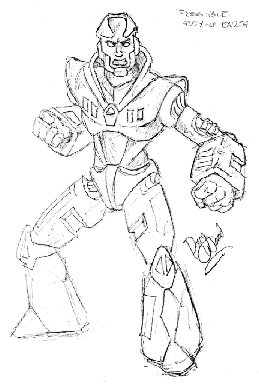
Early concept sketch of the player and the suit. Looks a lot like Megaman.
 From
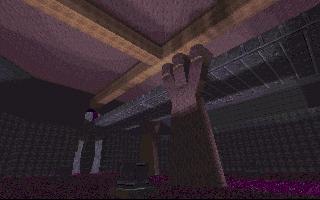
the beginning, Prey was designed multiplayer, user modification, and scalability
in mind. Prey even included a C like scripting language, much like Quake
and Unreal have. The 3D engine started off as software only, but later
added hardware support for 3D cards. Also dynamic lighting was a big
feature of the early engine. The online portion included a feature where
the player is able to seamlessly jump from one server to another. This
might not sound like much today, but in early 1996 this was huge.
From
the beginning, Prey was designed multiplayer, user modification, and scalability
in mind. Prey even included a C like scripting language, much like Quake
and Unreal have. The 3D engine started off as software only, but later
added hardware support for 3D cards. Also dynamic lighting was a big
feature of the early engine. The online portion included a feature where
the player is able to seamlessly jump from one server to another. This
might not sound like much today, but in early 1996 this was huge.By March 1996 we had a character on the screen moving around, elementary net play with frag bar, items to pick up, and things were looking good. But we still weren't happy with the engine yet, even though we had 3Dfx support in and working. The lighting just wasn't quite right.
William Scarboro (engine programmer) kept tweaking things and about mid year, we all decided to roll the dice again and support hardware acceleration only. It was a bold decision, but we felt the timing was right and it was the only way we could get some of the cool features we wanted in the game. We wanted to be cutting edge. So William went back and rewrote the engine again, this time specifically for hardware (3Dfx first). At the same time he was re-writing "Preditor", our in-house editor for Prey.
In April, 1996, the world was given its first real look at the game when, the now defunct, Titania Magazine conducted the first preview of the game and the first interview of the Prey team. The preview also included a number of concept sketches. Thanks to author Martian Kozicki for letting me post the interview and preview in its entirety; there have not been any online copies of for a few years now, so this is a rare look into Tom Hall's Prey.
More early previews include PC Gamer from May 1996 and Gamesdomain from July, 1996. Notice the team was hoping to finish the game by Christmas 1996.
 |
PREY: "You are and you'd better!" (tm) |
|
The second Prey logo, from 1996. Created by Brian Martel |
Where are they now?
Tom Hall is asked why he left the company. After Black Monday, George Broussard tried to calm everyone down in his .plan and this interview and announced job openings immediately. And so the Prey team began to build up again. Although Black Monday was a major setback for the project, 3D Realms were not going to give up that easily.
First, the engine and editor started a redesign phase. During this period, there was no game design, only work on technology. A new creative lead was needed for the project.
Another wave of developers later left to form Rebel Boat Rocker, which didn't help Prey either:
PREY: "If you don't come back, they will!" (tm)

Perhaps the golden age of Prey; the team grew in size and the pace sped up. Also, a new character and epic storyline are introduced. 3D Realms put out a press release on the new Prey leader.
A new logo for a new team. Created by Scott McCabe in early 1997.
George Broussard on the new beginning:
Near the end of 1996,we started hiring new core team members. We started with Paul Schuytema, who used to be a reviewer with CGW. We liked his style and found out he was producing Mech Warrior 3 for FASA. We figured that if they thought he was good enough for Mech Warrior, we'd give him a call. A few short weeks Paul was here, and he threw out all the old Prey stuff and started re-doing the Prey story (which I was much more happy with).
Things picked up fast from there. William got the new engine running under 3Dfx with 16 bit art and colored lighting, and we hired more people on. Scott McCabe and Allen Dilling came on for art and Tom Pytel came here to code everything William couldn't. The game was also being converted from DOS Win32 during this time.
Paul Schuytema talks about the first half of '97:
The early months of 97 were focused on refining the abstract concepts of the engine (to make it as robust and general as possible), nailing down our own video API and low-level system programming, and polishing up Preditor.
In late April, the first public Prey demo was unveiled at CGDC (the Computer Game Developer's Conference) in San Jose. The non-interactive demo ran so smoothly, and with such visual fidelity, that many thought that it was a pre-rendered AVI. They were floored when they learned that it was the engine, generating the visuals in real-time.
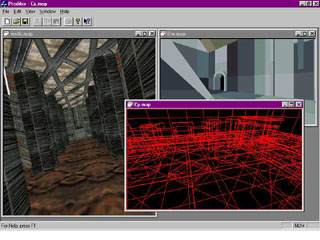
By early summer, Preditor had evolved into the most advanced 3D editor we'd ever seen. The speed of the interface, and the fact that the editor uses the engine directly, means that a mapper gets to see the results of his work instantly. In addition, the mapper has almost psychotic control over every single polygon in the map.
For even more information on the development of Prey during this period check the development updates.
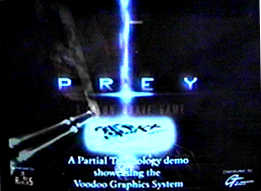 At E3
1997, Prey showed its stuff. A non-interactive demo was shown, and
everyone got a peek at a weapon or two and a few characters in the game.
That's just the beginning, Paul Schuytema gave demos to press and this is where
we can come as close to actually playing the game: Infinite
MHZ Interview.
At E3
1997, Prey showed its stuff. A non-interactive demo was shown, and
everyone got a peek at a weapon or two and a few characters in the game.
That's just the beginning, Paul Schuytema gave demos to press and this is where
we can come as close to actually playing the game: Infinite
MHZ Interview.
The demos showed off the Portal Technology the Prey Engine uses, plus the ability to destroy environments. Here is one of the many previews after the '97 E3 showing and an interview.
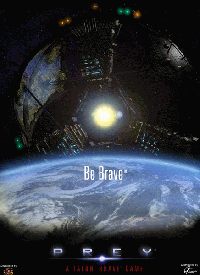
By now, details of the new story have emerged. Talon Brave is the main character; a new motto: "Be Brave"; and a plot with Talon being abducted by higher life forms that are responsible for the creation of the Earth.
 Some more on the story from Paul:
One of the key aspects of the Prey story is that Talon is a reluctant hero. He isn't an Arnold-esque caricature-he's more of a common man who's had a hard life. When he gets sucked into the story, it certainly isn't his choosing to do so.
"Talon's challenge in Prey is to survive his encounter with the Trocara, a trinity if alien species who live within a giant mothership (it's a variation of Larry Niven's Ringworld concept). Talon also discovers a mysterious fourth species, the Keepers, who lurk "in between the cracks" of the Trocara. Talon's initial quest is survival, but it soon turns into something far greater..."
When I heard this fact about being based on Ringworld, I went and read the book. And I must say the scale of the setting is really mind-blowing. The game Halo later used a similar idea.
|
|
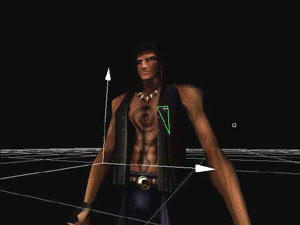
In addition, information on the technology behind Prey began to surface. The whole game is run on top of PreyOS. The tools consist of Preditor, the level editor, and Skinner, the object and texture utility. PreyOS was a lower level console driven program where you could do everything from load up a game of Prey to browse the files and directories on your computer. The tools, including Preditor and Skinner, run on top of the PreyOS.
Preditor has been described as a BUILD style editor where one walks through the level and editing in real time. It was intended to be included on the retail CD. Skinner opens files in VRML 2 format and helps to texture objects in the game.
The forth logo, from mid-1997. Prey is "A Talon Brave Game", one of many, as originally planned.
Around this time, the now defunct Gamecenter.com started posting a number of developer diaries written by the Prey team. In these, the mappers were now called "gamespace engineers". A great deal of information is included in this series.
Soundtrack
A big surprise in the area of music occurred in Nov 1997. It was announced that KMFDM was to compose the music for the game, and they did deliver:
In my last update, I told you that we were expecting some new KMFDM material. Well, it came (4 theme tracks), and boy, does it rock! The whole team, in shifts, filed into my office, we closed the door, cranked up my stereo and let it rip. By the end of the CDR, our jaws were hanging open-this is some of the best stuff I've ever heard from KMFDM (that's what Sascha promised us, and it looks like they're delivering).
While it'll be some time before you can hear their tunes (though those of you "lucky" enough to brave the mayhem of E3 will get a short aural peek), I thought I'd fill you in a bit on how they're working on the music.
Our approach is simple-build the body of music out of a small collection of recognizable themes. KMFDM and I have been working together on designing the various Prey themes. Of course, there will be the main game theme, plus themes to represent each of the species of the Trocara (as well as the Keepers), and some other themes to represent other key characters in the game.
I put together some emotional descriptions of the various themes (like, how are you supposed to feel when you hear the Keeper's theme, for example), plus relevant backstories. From there, the band has been working on different approaches-one great idea that Sascha and Tim had was to attribute a certain beat speed to each of the Trocaran species. The latest CDR that they sent has rough versions of four themes, and it was cool to close our eyes and listen-we could really visualize the Trocaran species through their music.
We then put together our comments and thoughts on the themes to sent back to them for revision. Right now, they've gathered together (some members of the band live overseas) in Seattle for a month of studio work, laying down tracks for us and for their next album.
Currently, most of the music has never been heard by the public. However, some of the theme music can be heard in the background of the 1998 E3 video.
Into 1998, work progressed at full speed. Toltec Audio Engine from Power Micro Research was integrated into the engine, DirectX6 support was added. It was also said that Prey's engine was scalable up to the Pentium 4 and Itanium processors.
 Enter
E3 1998
Enter
E3 1998
A little more professional non-interactive demo loop was shown at this E3. Also, the TV show, Infinite Mhz, conducted a video interview in the back room. This is the best look at Prey that we have. Some later previews held some of the best information on the game to date.
Destruction Part II
By 1998, the Prey Team grew to its maximum, but they did not go on to deliver a shareware 1.0 version or a gold CD of Prey. Something happened. On October 13, 1998, George Broussard announced that Paul Schuytema and William Scarboro were no longer on the Prey team. Here is the original announcement:
In an effort to appease all the press that are contacting us, I have a brief statement. We will not go into details as they are nobody's business but our's and the parties involved. Paul Schuytema is no longer with us on the Prey project. We felt a change was needed on the game. William Scarboro has left by mutual decision. The partings were amicable and we wish them both well in future endeavors. People come and go in this industry all the time. Prey's release date is, as always, "when it's done".
It sounds like Paul was fired and William was planning on leaving anyways. An interview conducted on the same day reassured that Prey would go on. Yeah. Some more articles on the news from GameSlice. But as the months passed on, developers began to disappear from the Bio page (Now removed completely from the website, probably for these reasons) at 3D Realms. Quietly, developers were either moved over to the Duke Nukem Forever team or they quit the company. Below, a list of the Prey team at its height and where the developers have gone. Thanks to various 3D Realms developers for providing this information.
Paul Schuytema (Project Leader) started
Magic Lantern Playware and made the
Survivor game.
George Broussard (Executive Producer) - DNF Team
William Scarboro (Programmer) - Died of an asthma attack
on August 9, 2002, at the age of 31.
 Tom Pytel (Programmer) - One of the founders of PayPal
Loyal Bassett (Programmer) - Possibly went to Microsoft.
Steve Hornback (Artist) - Went to Rogue Entertainment, now at Ritual Entertainment.
Scott McCabe (Artist) - Joined Paul at Magic Lantern Playware.
Allen Dilling (Artist) - Now at Blizzard Entertainment
David March (Artist) - Went to Ritual, then Crytek, and is now
teaching at The Guildhall in SMU in Dallas.
Matt Wood (Mapper) - DNF Team, then Valve.
John Anderson (Mapper) - DNF Team
Martinus (Mapper) -
Lee Jackson (Sound/Music) - Unknown.
After he left the company, the late William Scarboro made a few posts on Usenet about Portal Engines, perhaps giving some insight into what happened.
Been there, done that. I coded what was going to be the Prey engine for the game Prey from 3D Realms; there was an exodus of people from the team, including myself, and the engine has since been scrapped. I'm really not a big fan of portal engines anymore, especially where all rooms are relative (which is what I had) in the manner you propose. There are many ugly problems in maintaining such an engine: two rooms linked by more than one portal (which results in rendering a room twice, basically, and even though they won't overlap, all the culling and transforms are duplicated), graph maintenance with spatial discontinuities, collision detection through portals, handling sound where one sound can seem to be coming from many different locations, rendering characters moving across portals that the z-buffer won't handle correctly, etc. It wasn't fun. The effects were really awesome, though.
In hindsight, portal tricks such as these should be used as tricks, not as an engine paradigm.
William Scarboro
What I had in Prey was an entirely different beast; the entire game universe was hierarchical, meaning the entire universe was one big skeleton which could be transformed beyond belief, and I had a visual motion editing system that was righteous. Even the portals could be moved all over the place, following hierarchical spline paths, opening and closing. It was cool.
As I'm still into graphics, planning on doing stuff at home and perhaps getting back into the game industry, I may recode and restructure what I had to make it nice.
William Scarboro
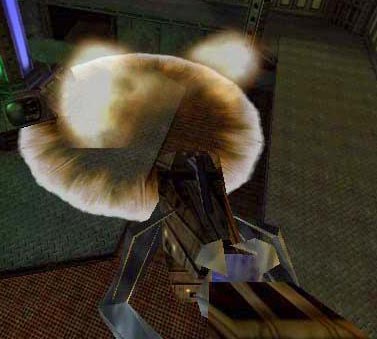
For the second time, Prey was without a creative leader for the game. The game design portion of the project came to a standstill. Meanwhile, Corrinne Yu, the Director of Advanced Technology at ION Storm, was hired by 3D Realms in November of 1998. 3D Realms decided to give one last try at developing a next generation in-house engine, and Corrinne was the one to do it. The press release stated "Prey and Duke Nukem 5 (tentative title) will be the first games to use this technology."
Throughout 1999, Corrinne worked on a top secret engine. With her impressive background, it seemed like nothing could go wrong. Scott Miller mentioned that her work was impressive, but no specifics of this project are known. During this time, the DNF project was ramping up. It was assumed everything was going fine with the next Prey engine too, but that was not the case. An editorial at Avault speculated a bit.
In early 2000, Corrinne was gone (fired?) with no explanations. I suppose 3D Realms finally gave up on creating their own engine. Corrinne did make many posts on Slashdot around this time and posted on Yahoo's message boards once in a while. It appears Corrinne Yu has started a new game company called Elapse Software (which later disappeared too).
It should also be mentioned that all Prey content was removed from 3DRealms.com, including all related press releases and files on the FTP server, in March 2000. It was also around this time that 3D Realms went into Area 51 mode and nearly shut off all information flow on upcoming projects.
After a multi-year blackout, on April 15, 2005, it was confirmed that Prey has been in development at Human Head Studios with project leader Chris Rhinehart since late 2001. Additional character models have been provided by Liquid Development.
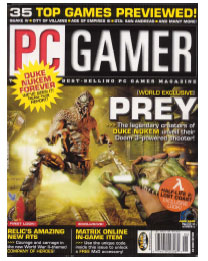
Here is what is known from the PC Gamer (June 2005 cover story) article:
On April 26th, 2005, Prey was officially announced and Take 2 Imperative's 2K Games label will be publishing the game for retail in 2006. Triton will (optionally) deliver the game online.
With next generation game console launches, E3 2005 was one of the largest ever. Prey had a presence at the show, especially when attendees entered the lobby. Inside, the ATI Theater ran movies of two games: Remedy's Alan Wake and 3D Realms' Prey. Luckily, you didn't have to go to the expo to see the 11min 30sec demo, since it is available for all (IGN, GameSpot)!
The rest of 2005 brought previews from Computer Games Magazine and Play Magazine. The game was announced for the Xbox 360 in addition to the PC. A trailer for that system was shown on G4TV on Nov 21.
In Janurary 2006, Weekly Updates began, directly from Prey Project Lead, Chris Rhinehart.
In February 2006, 1UP issued a week long series of articles/interviews/videos about the game.
Venom Games, located in NewCastle, England, is porting Prey to the Xbox 360, to be simultaneously released with the PC version. It sounds like Prey is a PC game first however, since the main developer is concentrating solely on the PC.
Release Date Watch:
More Information: Official Website, Official Message Board